This topic sufficiently piqued my interest. I wanted to explore the idea of things that should be valued in the moment, or valued as a record, and realized we could consider the following matrix:
Not valuable in the moment
Valuable in the moment
Not valuable as a record
Cutting my toenails
Fireworks
Valuable as a record
?
Wedding
(Yes, I too could think of a reason why cutting my toenails could be either valuable in the moment or as a record, but that’s not the point and you know it)
It was hard to identify something for “Not valuable in the moment” but “valuable as a record”. Of course, these are subjective judgements, but I think I tended to lean towards valuing most things in the moment, regardless of how mundane they are. I wanted to put something like “meal times”, or “journaling”, or “practicing piano”, since making records of all these things could be more valuable that the act of doing that thing once, in the moment. But, the possibility that something could be more valuable as a record is more of a creative endeavor. If someone with a sharp eye recorded every firework they’ve ever seen and created some kind of shocking art piece with these records – that could be very valuable. I classify this as “overthinking” it.
I think even if the intention is to amalgamate records, one should seek to value the moment. I hope to explore whats going on here more in future blogs.
We went to the Holiday Boat Parade at the Wharf today. It was packed with people. We fought our way through the crowds to catch a few glimpses of some dressed up boats, but what really stole the show was the fireworks. The finale was just phenomenal; it felt like a kid had been given an unlimited budget and did what any kid would do – see how many fireworks they can make go off at once. It was briefly daytime at 8pm on December 6th.
But what baffles me to this day is all the people recording videos of the fireworks. Sure, I get the urge, “this is really cool, let me immortalize it”. But who has ever gone back and watched a video they took of fireworks? Seriously, leave a comment below if you have, I am dying to hear about it. In this day and age, enough of these people have had phones long enough to have learned this lesson. Just enjoy the moment for what it is, a fleeting spectacular.
I was recording the people with their phones up, not the fireworks. I swear, I’m differentTM
I suppose this ties into our “need” in this day and age to record everything. Of course, recording things is a great habit. Just look at me with this dang blog. Look at our wedding photo album. I wonder if there’s a heuristic we can use to determine “fireworks” or “wedding”. I.e. something worth more in the moment than it ever could be as a record, and something that is too important to not be a record.
You all know what I’m talking about. We all know at least a few people that wear their keys on their belt loop, probably with a carabiner. You can hear them coming from a mile away. I’ve never really considered it an option.
Until the thousandth time that I’ve reached into my pocket to get the right key and it’s a jumble. It’s uncomfortable. Despite what feels like hours of searching in there with my hand, I will inevitably still come out with the wrong key or object. So lets consider a pros and cons table. Also just testing out WordPress’ table feature.
Pros/Cons of wearing keys on belt
Pros
Cons
More comfortable
Loud
Easy to access
Being “that” guy
Less spiky to me in my pocket
Probably more spiky to other people
Get to own cool carabiner
Have to buy carabiner
Well, I guess that’s something to consider.
Oh, by the way, I’m going to start doing more of these mini blogs. And I’ll put them in categories so that I can have mini series. I think I was putting too much pressure on a single post previously and that might have stopped me from posting more often.
Whoa, a blog two days in a row. Look who’s getting all serious.
So, if you have been one of our avid readers, you may have though to yourself “things look different around here”. And that’s because we have officially switched to a whole new platform. What’s going on is officially a WordPress blog.
I chose to switch to WordPress from Ghost for a couple of reasons:
WordPress offers more flexibility in post, and site, layout.
Ghost is more newsletter focused, whereas WordPress is a bit more generic.
I wanted try to out something new. Ghost wasn’t inspiring me. Hopefully WordPress will.
Well, that’s what’s going on with the new look. If you have any feedback, please leave it in in the comment box below. Thanks for reading!
Our previous TLD – “cc” – turned out to be problematic. It is often filtered by email filters, and blocked by strict firewalls. This is because it has historically been used by malware and spammers.
Our new domain is a .com, so it’s exceedingly normal. Not to mention, the name is much more fun. Can’t wait to get back to making content!
When I first created this blog, I did not expect to be showcasing brand new recipes, but this one was just too good not to share. If you like pain au chocolate, but you don’t want to go through all the effort of making crazy pastry dough, or you don’t want to spend a fortune at a bakery, worry not; this recipe is your answer. The recipe speaks for itself, so I won’t have a long intro like every food blog (you’re welcome). There aren’t any pictures, because I ate them all before I could take any.
Blog. B-l-o-g. Bllllllog. B-log. The word comes from web-log. Did you know that? I did not.
But if I’m going to have a “blog”, I should know better, so lets set some goals for this post.
Post Goals
Understand how blogs came to be.
Describe the current blog landscape
Find out what makes a good blog.
The first blog
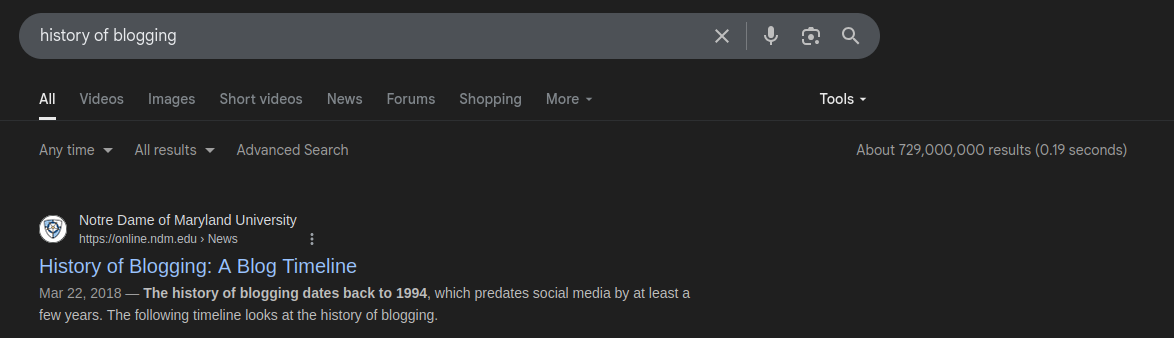
There are hundreds of articles online detailing the history of blogging. Google is quick to brag about having 729 million results when performing this query. However, as per usual, that number is clearly inflated – it doesn’t take long before the results are hardly relevant. I took a little journey anyway. The most interesting result being on page 17; a link to the James Webb Space Telescope blog (https://science.nasa.gov/mission/webb/). Why is it the most interesting? Well, Space is cool, space telescopes are cool (definitely a topic for a future post), and while it’s neat that “Webb’s blog” almost has three b’s in a row – it’s also very close to the original term, weblog.
I could write another article about the history of blogging, maybe I’d make it to page 16 (that’d still put me in the top 0.00003% of results – or the 99.99997th percentile – not bad!). I have an idea that sounds a little more fun: let’s go explore one of the very first blogs together.
This page is widely reported to be one of the first blogs. The domain name, links.net, gives us a hint as to what got this guy excited in the beginning – I’ll get to that. What’s maybe the most impressive about his site is that he still posts. He has been posting on his blog for over 31 years. That’s a year longer than I’ve been breathing air; I’m pretty good at breathing by now, so I’d imagine he is at least as good at blogging. Reading and clicking through his page proves that to be… true..ish.
What do I mean by that? Well, if you spend enough time on links.net you will find something that will surprise you. I promise. Go ahead, click around on it (but please be a little bit careful – don’t say I didn’t warn you). The layout of the website is nowhere near apparent – at first glance it seems to be a labyrinth of links. Let’s start at the beginning (afterall, I’m supposed to be finding out how blogs came to be. That’s what I promised you). There’s so much to unpack.
First of all, this guy was very excited about “HyperText” and the “World Wide Web”. HyperText itself wasn’t a new concept, around since the ’60s, but HTTP (HyperText Transfer Protocol), developed by Tim Berners-Lee was recently released (1991). You’ve probably heard of him before? Known as the founder of the internet, or more specifically the WorldWideWeb, W3, WWW, however you want to call it.
One of the things I find fascinating that reveals a huge difference between the web then and now: his “link of links” page. Today we are entirely reliant on search engines. Well, we were, now LLM’s are starting to take hold – that’s a blog topic for another day. But back then it was common for people to have pages of links to websites they liked or found cool and wanted to share. And this was a primary way of, “surfing” the web, hopping from links, to lists of links, to more links. In Justin’s words: A good search engine will surf for you, but don’t think that cuz they don’t find it, it ain’t out there. You often got to start at one site and work your way into the hidden, uncatalogued gems. ~Justin hall
This one is kind of an aside – but clicking around his site I eventually came across the “the first www page“. You can even access it using a simulator that simulates the experience of the first widely available web browser – a line mode browswer. I had never come across this before, so I got a little giddy when I found it.
I’ve could go on and on about his page, but I’ll let you explore. Those were my immediate observations. Again, if you want a more in depth history of blogging, there are ton of articles on it. But before we move on to the next topic, I want to share with you an actual article on the history of blogging, by Rebecca Blood. I mean, it was written in 2000, so doesn’t even cover two thirds of all blogging history, but it’s absolutely worth reading if you find the time.
Maybe I just liked it so much because of this one excerpt:
The blogger, by virtue of simply writing down whatever is on his mind, will be confronted with his own thoughts and opinions. Blogging every day, he will become a more confident writer. A community of 100 or 20 or 3 people may spring up around the public record of his thoughts. Being met with friendly voices, he may gain more confidence in his view of the world; he may begin to experiment with longer forms of writing, to play with haiku, or to begin a creative project–one that he would have dismissed as being inconsequential or doubted he could complete only a few months before.
As he enunciates his opinions daily, this new awareness of his inner life may develop into a trust in his own perspective. His own reactions–to a poem, to other people, and, yes, to the media–will carry more weight with him. Accustomed to expressing his thoughts on his website, he will be able to more fully articulate his opinions to himself and others. He will become impatient with waiting to see what others think before he decides, and will begin to act in accordance with his inner voice instead. Ideally, he will become less reflexive and more reflective, and find his own opinions and ideas worthy of serious consideration.
I have started this blog because I want to be more thoughtful about how I learn about different topics, but also to improve my writing. However, after reading the above, I am updating my motivations to include becoming more reflective and therefore confident in my own thoughts. With constant inundation and stimulation of shorts and news, this can’t be a bad thing.
Current blogging landscape
I’ll be honest with you, this question doesn’t excite me as much. But, I’ll start with numbers, I love numbers – who doesn’t love numbers. You might think “who blogs anymore? anyone who’s anyone on the internet is on instagram… right?”. Well, you’re wrong (but also maybe instagram is kinda a blog… kinda). Blogs come in so many shapes and forms. Some facts (and yes, another history of blogging article) from webtribunal.net:
More than a third of all websites are blogs
Tumblr hosts the vast majority of blogs with 518 million
WordPress, for all its fame and widespread adoption, is a distant second with 60 million.
More than 6 million posts go live every day, on average.
I was interested to see how Ghost, the platform I am using, stacked up. Ghost has 22,000 active customers, and an estimated 5000 self-hosted users (I am one of those ~5000). So small pickings for Ghost. But when I make this post, it will be one of the 6 million that day!
A lot of blogging these days seems to be for the purposes of search engine optimization. Many businesses have blogs to increase traffic to their websites. Increased traffic, and more words and links on your website also will increase its chances of showing up in someone’s web search.
There’s a lot more someone could say about this topic, but I’m choosing not to, primarily because of what my answer is for the last topic.
What makes a good blog
To know what makes a blog good, you have to consider what is the reason the person is blogging. This could be personal growth, social interaction (for some blogs like tumblr), building an internet presence, search engine optimization for a business, or just to straight up make money. The platform I am blogging on has the ability for paywalls – you’re lucky because you are getting all of these premium content for FREE! Anyway, the reasons are diverse, and therefore what will make a blog good is probably also diverse – aside from the obvious rules such as “well written”, “interesting topics”. Here are a few rules I’ll posit:
The writer should be interested in the topic. This is why I chose not to continue to write about the last topic. A business oriented blog might not have such a luxury, but I’m sure it shows when someone is not enjoying writing about something.
The blog should provide value to at least one of the writer and the reader. I think for a personal blog, the former is probably more important.
The blog that is written is always better than the one that is not.
So that’s whats going on with blogging! This post is what my brain came up with for this topic, and that’s ok. Stay tuned.
I’ve never had a blog before, so before diving into more interesting topics, I’m going to set some ground rules for what you, the reader, can expect. And for what I am expecting of myself. I am considering this post to be a living document – I will update it to fit my needs as the blog evolves.
Goals (of this post)
Purpose and vision statements.
Define what a blog post will and won’t be.
Purpose:
This blog’s primary purpose is for the externalization and organization of my learning about topics that interest me.
The secondary purpose is to practice my writing.
What this blog is
I will
write about any topic that I choose. This blog is a space for curiosity-driven exploration. I’ll be diving into topics I know nothing about, as well as those in which I am well versed.
be conducting my own research, and documenting my learning journey.
openly acknowledge my lack of expertise, never misrepresenting my work as an authoritative source.
Each post will
have a title that finishes the question “What’s going on …”.
be as accurate and objective as I can make it.
What this blog is not
Each post is not guaranteed to be
a definitive guide to the considered topic.
free from inaccuracies.
Vision
“A space for learning and writing – led by curiosity.”